

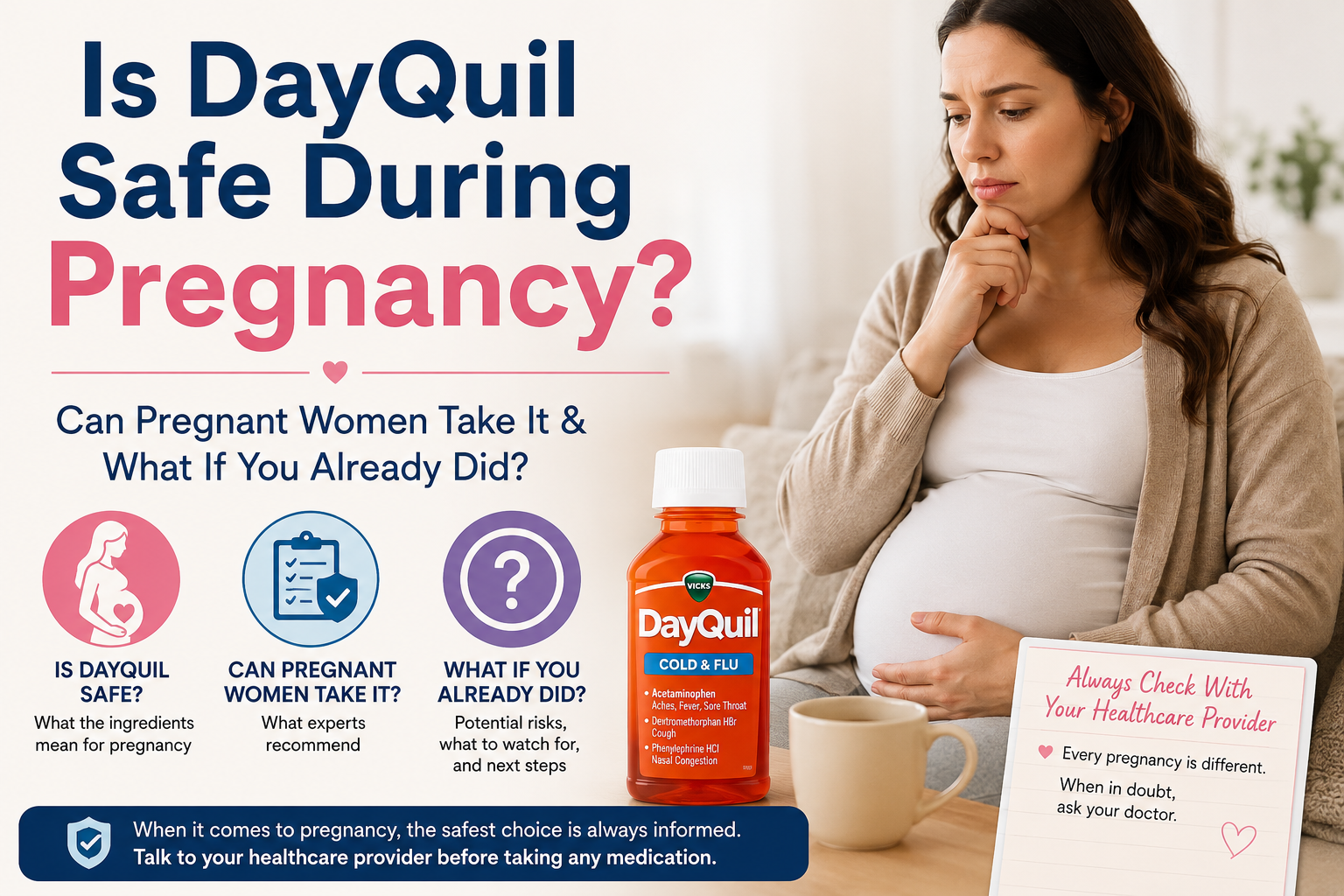
When you are pregnant and dealing with a blocked nose, cough, sore throat, fever, or body aches, it is natural to reach for whatever cold medicine is already at home. But then the worry starts: is DayQuil safe during pregnancy? And if you already took it, you may be searching I took DayQuil while pregnant and wondering if you should panic.
The short answer is: DayQuil is usually not the first-choice cold medicine during pregnancy because it is a multi-symptom product and many versions contain phenylephrine, a decongestant many pregnancy medication lists advise avoiding unless your healthcare provider specifically recommends it. VCU Health lists DayQuil and NyQuil among medications to avoid in pregnancy because they contain phenylephrine, and it also advises avoiding “all-in-one” combination cold medicines when possible.
Quick Answer: Can Pregnant Women Take DayQuil?
If you are asking can pregnant women take DayQuil, the safest answer is: do not take it unless your OB-GYN, midwife, doctor, or pharmacist says it is okay for your specific pregnancy.
DayQuil is not just one simple medicine. Standard Vicks DayQuil Cold & Flu liquid contains acetaminophen, dextromethorphan, and phenylephrine. The DailyMed label lists acetaminophen as a pain reliever/fever reducer, dextromethorphan as a cough suppressant, and phenylephrine as a nasal decongestant. The label also says that people who are pregnant or breastfeeding should ask a health professional before use.
So, is DayQuil OK during pregnancy? It depends on the exact product, your trimester, your symptoms, your blood pressure, your medical history, and whether you are taking other medicines. For many pregnant women, doctors prefer choosing single-ingredient medicines that treat only the symptom you actually have, instead of a combination product.
Why DayQuil Is Tricky During Pregnancy
DayQuil can feel convenient because it treats several symptoms at once. That is also why it can be a problem during pregnancy. You may only need help with a cough, but the product may also contain a decongestant. You may only need fever relief, but you may also be taking another product with acetaminophen without realizing it.
MotherToBaby advises avoiding combination cold, cough, and flu medicines when possible during pregnancy, and instead choosing single medicines that target the symptom you have unless your healthcare provider says otherwise. It also notes that some cold and cough liquids contain alcohol, so labels should be checked carefully.
This is the main reason many doctors are cautious with DayQuil. It is not always that every ingredient is automatically dangerous. The concern is that multi-symptom cold medicine can expose you to ingredients you may not need.
What Is Inside DayQuil?
Different DayQuil versions may have different ingredients, so always read the Drug Facts label on your bottle, caplets, or LiquiCaps.
Common DayQuil ingredients include:
Acetaminophen for fever, headache, sore throat, and body aches
Dextromethorphan for cough
Phenylephrine for nasal congestion
Guaifenesin in some “Severe” versions to loosen mucus
For example, DayQuil Severe Cold & Flu contains acetaminophen, dextromethorphan, guaifenesin, and phenylephrine in each 15 mL dose.
Acetaminophen in DayQuil
Acetaminophen is the fever and pain-relief ingredient in DayQuil. On its own, acetaminophen is commonly used during pregnancy when needed. ACOG states that acetaminophen can be taken during pregnancy, but pregnant patients should talk with their OB-GYN before taking any over-the-counter medicine.
The important safety issue is dose. DayQuil already contains acetaminophen, so you should not combine it with Tylenol or another medicine that also contains acetaminophen unless your healthcare provider tells you how to do it safely. The DayQuil label warns that severe liver damage can occur if too much is taken or if it is taken with other acetaminophen-containing drugs.
Dextromethorphan in DayQuil
Dextromethorphan is the cough suppressant in many DayQuil products. It is often considered one of the more acceptable cough medicine ingredients during pregnancy when needed.
MotherToBaby says dextromethorphan use in pregnancy is not expected to increase the chance of birth defects, and it recommends choosing alcohol-free products if dextromethorphan is needed during pregnancy. Nebraska Medicine also lists dextromethorphan as a safe cold and flu medication option during pregnancy, while reminding patients to read labels and avoid exceeding the recommended dose.
Still, it is better to use it only when you actually have a cough that needs treatment, not just because it is included in a combination medicine.
Phenylephrine in DayQuil
Phenylephrine is the ingredient that makes many doctors cautious about DayQuil during pregnancy. It is an oral decongestant used for stuffy nose and sinus pressure.
MotherToBaby explains that phenylephrine can narrow blood vessels and has theoretical concerns about reducing blood flow through the placenta. It may also raise blood pressure, so people with high blood pressure should speak with their healthcare provider about safer options.
There is another issue too: the FDA has proposed removing oral phenylephrine as an over-the-counter nasal decongestant because available data show it is not effective for nasal congestion. The FDA says products containing oral phenylephrine can still be marketed for now, but patients should read the Drug Facts label and ask a doctor or pharmacist about options.
That means phenylephrine may be both not preferred in pregnancy and not very useful for congestion when taken by mouth.
I Took DayQuil While Pregnant — What Should I Do?
If your main worry is I took DayQuil while pregnant, try not to panic. A one-time dose does not automatically mean something bad will happen. The next step is to gather the details and contact a healthcare professional for personal advice.
Do this:
Check the exact product name.
Read the active ingredients on the Drug Facts label.
Write down how much you took and what time you took it.
Check whether you also took Tylenol, cold medicine, flu medicine, sleep medicine, or anything else with acetaminophen.
Call your OB-GYN, midwife, doctor, pharmacist, or local poison control service if you took more than directed or are unsure.
The DayQuil label says not to exceed the directed dose and to contact Poison Control or get medical help right away in case of overdose, even if there are no symptoms.
Is DayQuil Safe for Pregnancy in the First Trimester?
The first trimester is when many people are extra careful with medicine because early development is taking place. If you are in the first trimester, it is especially smart to avoid self-medicating with combination cold products unless your provider approves.
VCU Health lists acetaminophen and dextromethorphan as safe options for specific symptoms but advises avoiding DayQuil and NyQuil because of phenylephrine. Nebraska Medicine also says it is generally best to avoid multi-symptom forms of these drugs and to talk with your doctor before starting a new medication while pregnant.
Is DayQuil Safer in the Second or Third Trimester?
Some medications may be handled differently later in pregnancy, but that does not mean DayQuil automatically becomes safe for everyone. Blood pressure, gestational diabetes, preeclampsia risk, liver problems, other medicines, and symptom severity can all change the advice.
The safest move is still to ask your pregnancy care provider before taking DayQuil. Your provider may say to avoid it, or they may suggest a more targeted option such as acetaminophen for fever, dextromethorphan for cough, saline spray for congestion, or another medicine that fits your health history.
DayQuil vs Safer Pregnancy Cold Options
For many pregnant women, the better approach is to treat symptoms one by one.
For fever or body aches, acetaminophen may be recommended by your provider.
For cough, dextromethorphan may be an option, preferably in an alcohol-free product.
For chest congestion, plain guaifenesin may be allowed by some providers.
For nasal congestion, saline spray, humidifier use, fluids, or certain nasal sprays may be preferred.
For sore throat, warm saltwater gargles, honey in warm tea, or approved throat products may help.
Nebraska Medicine lists acetaminophen, dextromethorphan, guaifenesin, mentholated rub, cough drops, loratadine, diphenhydramine, and certain remedies as options, while also advising patients to read labels and never exceed the recommended dose.
Natural Remedies That May Help
Not every cold symptom needs medicine. For mild symptoms, simple comfort measures can help and may reduce the need for multi-ingredient products.
Try:
Warm tea with honey for cough and throat irritation
Saline nasal spray for stuffy nose
A humidifier for dry air and congestion
Warm saltwater gargles for sore throat
Rest as much as possible
Plenty of fluids
Elevating your head while sleeping
Steam from a warm shower to loosen congestion
Nebraska Medicine recommends humidifiers or saline-based nose drops/sprays, warm saltwater gargles, honey in warm tea, fluids, and rest as natural symptom-relief options during pregnancy.
When You Should Call a Doctor
Cold symptoms are usually mild, but pregnancy changes the risk picture. You should contact your doctor if symptoms are severe, not improving, or feel like the flu.
Call your provider if you have:
Fever that does not improve
Shortness of breath
Chest pain
Wheezing
Severe sore throat
Symptoms lasting more than a week
Dehydration
Reduced fetal movement later in pregnancy
High blood pressure or preeclampsia concerns
A cough with chest pain or trouble breathing
The DayQuil label advises stopping use and asking a doctor if symptoms worsen or last more than 7 days in adults, fever worsens or lasts more than 3 days, redness or swelling is present, new symptoms occur, or cough returns with rash or lasting headache.
What About the Flu During Pregnancy?
If you think you have the flu, do not just treat it like a normal cold. Flu can be more serious during pregnancy. Nebraska Medicine notes that influenza in pregnancy increases the risk of pneumonia, hospitalization, and ICU admission, and says the flu vaccine is safe during pregnancy.
Symptoms that may suggest flu include sudden fever, chills, body aches, extreme tiredness, headache, cough, and feeling much worse than a typical cold. Contact your provider quickly because antiviral treatment works best when started early.
Best Plain Answer
DayQuil safe for pregnancy is not a simple yes-or-no topic because DayQuil is a combination product. Many versions contain acetaminophen, dextromethorphan, and phenylephrine, and some Severe versions add guaifenesin. The biggest concern is usually phenylephrine and the fact that DayQuil treats multiple symptoms at once.
If you are asking can a pregnant woman take DayQuil, can pregnant women take DayQuil, or can take DayQuil while pregnant, the safest answer is: ask your OB-GYN, doctor, midwife, or pharmacist before using it.
If you already took it once, do not panic. Check the ingredients, check the dose, avoid taking more until you speak with a healthcare professional, and get urgent help if you took too much acetaminophen or have serious symptoms.
