

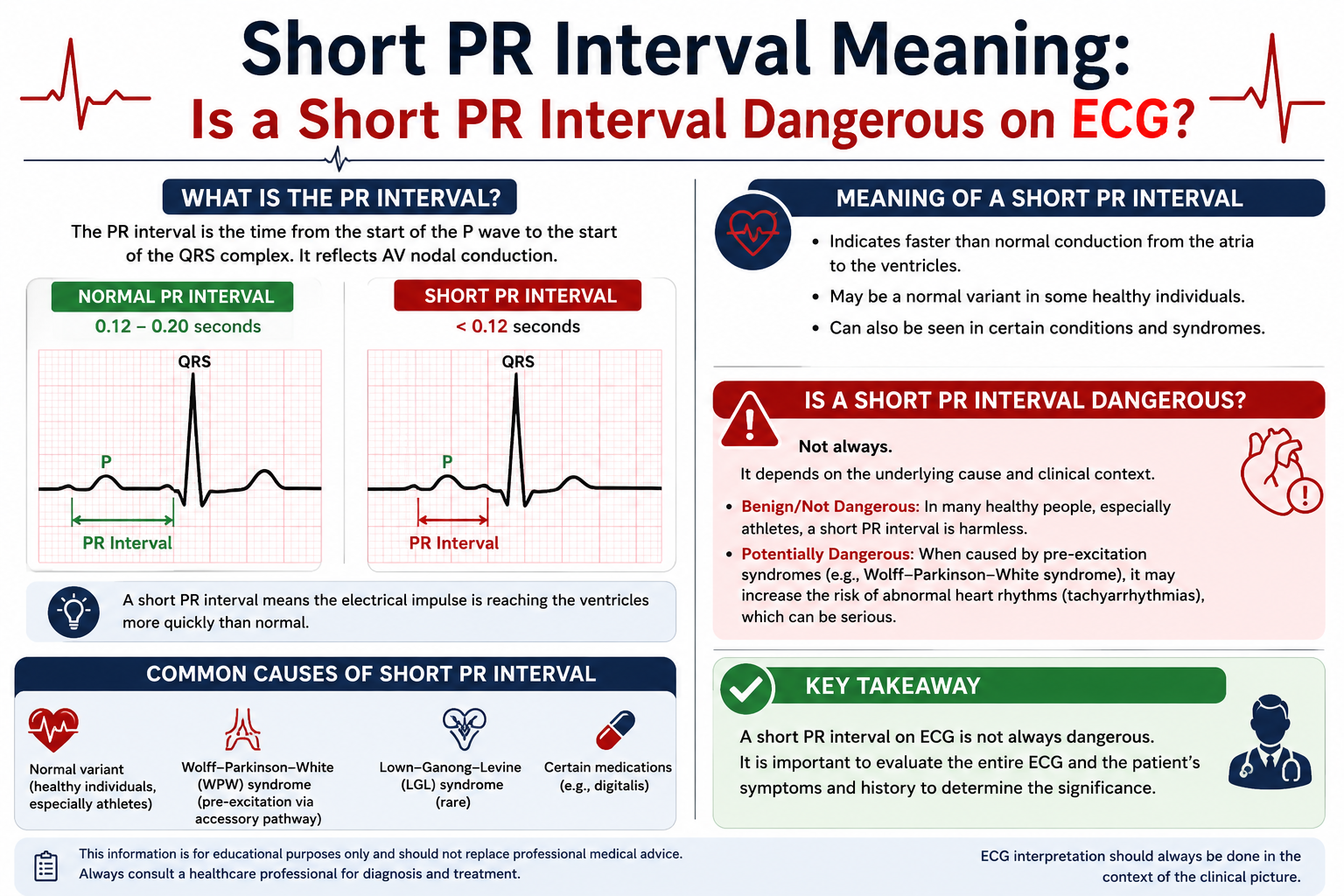
Seeing short PR interval on an ECG report can be confusing, especially if the rest of the test looks normal. Many people search short PR interval meaning because they want to know whether it is a harmless ECG note or a sign of a heart rhythm problem.
A short PR interval means the electrical signal is traveling from the upper chambers of the heart to the lower chambers faster than expected. On a standard ECG, the PR interval is measured from the beginning of the P wave to the start of the QRS complex. It reflects how long the signal takes to move through the atria, AV node, and into the ventricles. A normal PR interval is usually 120 to 200 milliseconds, and a PR interval under 120 milliseconds is considered short.
Quick Answer: What Does a Short PR Interval Mean?
In simple words, a short PR interval means the heartbeat signal is reaching the ventricles sooner than usual.
That can happen because of:
Faster-than-usual AV node conduction
An accessory electrical pathway
Pre-excitation, such as Wolff-Parkinson-White pattern
Junctional rhythm, where the signal starts near the AV node instead of the sinus node
A normal variant, especially if there are no symptoms and no other ECG abnormalities
The key detail is whether the short PR interval appears alone or with other ECG findings, especially a delta wave or a wide QRS complex. LITFL notes that a PR interval under 120 ms may suggest either pre-excitation or an AV nodal/junctional rhythm.
Is a Short PR Interval Dangerous?
A short PR interval is not always dangerous. Some people have an isolated short PR interval and never have symptoms or heart problems. But it can be more concerning if it is linked with palpitations, fainting, rapid heartbeat episodes, chest pain, or ECG signs of an accessory pathway.
So the best answer to is short PR interval dangerous is:
It depends on the full ECG and your symptoms. A short PR interval by itself may be harmless, but a short PR interval with a delta wave, wide QRS, or episodes of fast heartbeat may need cardiology evaluation.
This is why doctors do not interpret the PR interval alone. They look at the rhythm, QRS width, P waves, delta waves, heart rate, symptoms, and medical history.
Why the PR Interval Can Be Short
The PR interval includes the normal delay at the AV node. That delay is helpful because it gives the ventricles time to fill before they contract. If the PR interval is short, it may mean the electrical signal is bypassing part of that normal delay or starting closer to the ventricles.
Fast AV Nodal Conduction
Some people naturally conduct electrical signals through the AV node faster than average. If the QRS is narrow, there is no delta wave, and the person has no symptoms, this may be a less concerning pattern.
Accessory Pathway
An accessory pathway is an extra electrical connection between the atria and ventricles. It can allow signals to reach the ventricles early, creating a short PR interval. This is called pre-excitation.
Junctional Rhythm
In a junctional rhythm, the heartbeat signal starts near the AV node rather than from the sinus node. Because the signal begins closer to the ventricles, the PR interval may look short or the P wave may appear unusual.
Short PR Interval and Wolff-Parkinson-White Pattern
One of the main conditions doctors think about with a short PR interval is Wolff-Parkinson-White, often shortened to WPW. WPW happens when an extra pathway allows electrical signals to bypass the AV node and activate the ventricles early.
The classic ECG pattern of WPW includes:
PR interval less than 120 ms
Delta wave, which is a slurred upstroke at the start of the QRS complex
Wider QRS complex
LITFL describes WPW ECG features as a short PR interval, delta wave, QRS prolongation, and related ST-T changes. StatPearls also describes WPW pattern as a short PR interval with a widened QRS complex and slurred delta wave.
This is why the question is not only “is the PR short?” It is also: is there a delta wave?
Short PR Interval Without Delta Wave
A short PR interval without delta wave can mean something different from WPW. If the QRS is narrow and there are no symptoms, it may be a benign finding in some people. In athletes, a short PR interval without clear pre-excitation can be seen and may not require further evaluation if the person is asymptomatic and the rest of the ECG is normal. A European Heart Journal review states that an asymptomatic athlete with isolated short PR interval and no delta wave or other ECG abnormalities does not require further evaluation.
That said, a person with palpitations, fainting, or sudden fast heartbeats should not ignore it. Symptoms change the meaning.
Short PR Interval vs WPW: The Simple Difference
A short PR interval is an ECG measurement. WPW is a specific pattern or syndrome involving an accessory pathway.
| Finding | What It Means |
| Short PR interval alone | Signal reaches ventricles sooner than usual |
| Short PR + delta wave + wide QRS | Suggests WPW/pre-excitation pattern |
| Short PR + narrow QRS + palpitations | May need evaluation for rhythm issues |
| Short PR + no symptoms + normal ECG otherwise | May be a normal variant in some people |
The presence of a delta wave is especially important because it suggests early ventricular activation through an accessory pathway. LITFL describes a delta wave as a slurred upstroke in the QRS complex related to ventricular pre-excitation.
Symptoms That Make a Short PR Interval More Important
A short PR interval becomes more concerning when it appears with symptoms of a possible rhythm problem.
Watch for:
Sudden racing heartbeat
Fluttering or pounding in the chest
Dizziness
Fainting or near-fainting
Shortness of breath
Chest pain or pressure
Exercise-related palpitations
Episodes of very fast heart rate that start and stop suddenly
The NHS says WPW can cause episodes where the heart suddenly starts beating very fast, and symptoms may include palpitations, dizziness, shortness of breath, chest pain, or fainting.
When It May Be Less Concerning
A short PR interval may be less worrying when:
The person has no symptoms.
There is no delta wave.
The QRS complex is narrow.
There are no other abnormal ECG findings.
A previous ECG showed the same pattern.
A clinician has reviewed it and called it a normal variant.
Even then, it is still worth asking your healthcare provider what they saw on the full ECG. The report phrase alone does not tell the whole story.
What Tests May Be Done Next?
If a short PR interval is found, the next step depends on symptoms and the full ECG.
A doctor may consider:
Repeat ECG to confirm the pattern
Comparison with old ECGs
Holter monitor or event monitor if palpitations come and go
Echocardiogram if structural heart disease is a concern
Exercise testing in selected cases
Electrophysiology referral if WPW or recurrent fast rhythms are suspected
For WPW, treatment is not always needed if symptoms are absent or mild, but people with troublesome symptoms may need medicines or a procedure called catheter ablation. The NHS notes that treatment may be needed if WPW symptoms affect daily life, and catheter ablation is one possible treatment.
Can a Short PR Interval Cause Palpitations?
The short PR interval itself is a measurement, not a symptom. But if it is caused by an accessory pathway or a re-entry circuit, it can be associated with episodes of supraventricular tachycardia, where the heart suddenly beats very fast.
LITFL notes that accessory pathways can act as an anatomical re-entry circuit, making patients susceptible to re-entry tachyarrhythmias.
That is why palpitations matter. A person with a short PR interval and no symptoms may be handled differently from someone who has repeated sudden racing-heart episodes.
Is Short PR Interval the Same as Short QT?
No. A short PR interval and a short QT interval are different ECG findings.
The PR interval measures conduction from the atria to the ventricles.
The QT interval measures the time related to ventricular electrical activation and recovery.
They can mean different things and should not be mixed up. If your report says “short PR,” it is referring to the PR interval, not the QT interval.
What to Ask Your Doctor
Useful questions include:
How short was my PR interval in milliseconds?
Was there a delta wave?
Was my QRS narrow or wide?
Does this suggest WPW or just a short PR interval?
Is this new compared with my old ECG?
Do I need a Holter monitor if I have palpitations?
Should I avoid any medicines or stimulants?
Do I need a cardiology referral?
These questions help move the discussion from a scary phrase to a clear plan.
When to Seek Urgent Help
Get urgent medical care if you have a short PR interval report and symptoms such as:
Chest pain
Fainting
Severe shortness of breath
A very fast heartbeat that does not settle
Palpitations with dizziness or weakness
New symptoms during exercise
A family history of sudden cardiac death with symptoms
These symptoms can happen with different heart conditions, not only short PR interval, but they should be checked quickly.
Plain-English Meaning
Short PR interval meaning is simple at first: the electrical signal is moving from the atria to the ventricles faster than expected on an ECG. The normal PR interval is usually 120–200 ms, so anything below 120 ms is called short.
Is short PR interval dangerous? Sometimes yes, but often not by itself. It becomes more important if there is a delta wave, wide QRS, WPW pattern, or symptoms like palpitations, fainting, chest pain, or sudden fast heartbeat. An isolated short PR interval with no symptoms and no other ECG abnormalities may be harmless, but it should still be interpreted by a healthcare professional who can review the full ECG.
